Divemaster: Martin Bonert.
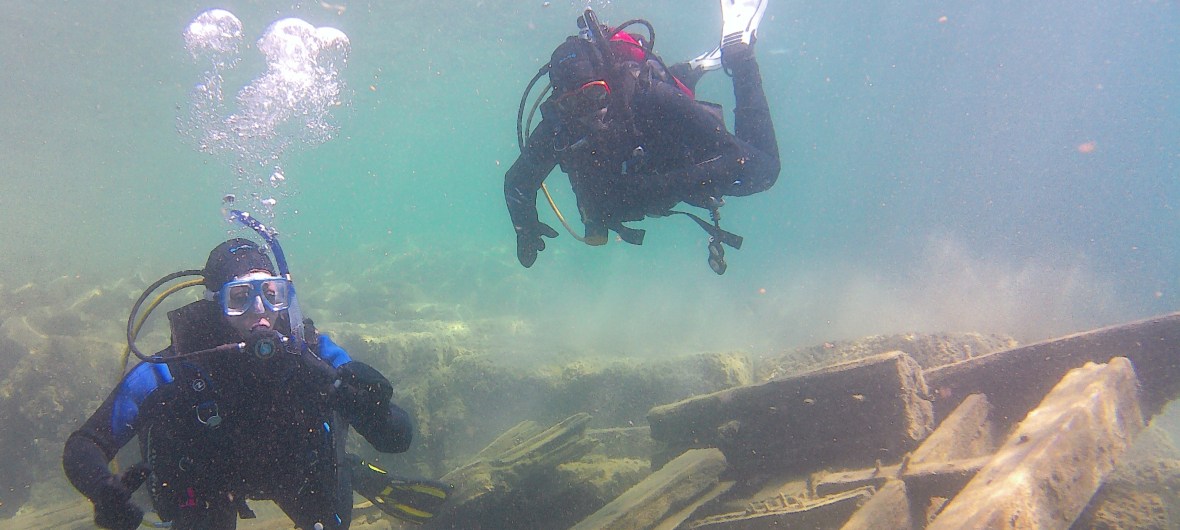
Eight divers met at Cedar Point on Saturday morning for a dive weekend that has been described as “absolutely AMAZING!” Our Blue North divers, under the direction of Martin Bonert, dove aboard the Georgian Ranger with Captain Steve Wallace. The weather was perfect with very few waves on Saturday and almost completely flat conditions on Sunday. They dove the Marquette and Mapledawn on Saturday and the Thomas Cranage and Michigan on Sunday. And snorkeled the Lottie Wolfe as a bonus wreck on Sunday.
Photos
See the Photos from the dive weekend
Marquette
The Marquette sank in 1867, damaged in a storm, where it dropped anchor on the lea side of Hope Island to make some repairs. A sudden wind shift caught the crew off guard, finishing off the job the storm had begun, sending the schooner to the sandy bottom at 35ft. The Marquette is currently the most intact of the area’s wooden wrecks. It was discovered when wreck seekers were looking for the wreck of the Imperial, and eventually realized the dimensions didn’t match. It has now been confirmed the Marquette. The Imperial has never been found.
.
Mapledawn
The Mapledawn (350 ft.) is a steel freighter, with a massive in-line quadruple expansion engine. It was originally launched as the Manola in Cleveland circa 1890. It is believed that she was sold to serve in WW1 and had to be cut in two for transit through the St. Lawrence, to be put back together at Montreal. However, the bow section of the Manola was lost in a storm off Quinte, putting an end to the sale. A new bow section was made, and she was reborn as the Mapledawn and launched in 1920. On Nov. 30, 1924 the Mapledawn was lost in a snowstorm. During the reduced visibility of the storm, this dive-site-to-be ventured too close to shore. Hitting one of the many submerged rocks in the area, a section of the stern with propeller and a portion of propeller shaft attached was snapped off, flooding the engine room almost instantly. This section lies in slightly deeper water just to the northwest of the main body of the wreck. The location of the rudder is unknown. Helpless without power or steerage and pushed by wind and waves, she was very soon hard aground. Two men made it to shore, hiked across the island to an Indian Reservation for help and all hands were saved. As a footnote to history, one of those two men returned some weeks later and tried to recover some personal effects left on the vessel during the disaster, but drowned in the attempt.
.
Thomas Cranage
The Thomas Cranage (305 ft.) is the longest wooden steamer to be built on the Great Lakes and began life in Michigan in 1893. This vessel ran aground Sept 25, 1911. The cargo of grain was removed, but the storms broke up the steamer. Today the scattered remains are found in 15-55 feet of water straddling Watchers Reef about 2 kilometers north of Hope Island. The largest portion of the wreck is the bottom of the hull in the shallow waters where she ran aground. All of the larger machinery was salvaged at the time of the disaster, including the engine. On the north side of the reef is the bulk of the Cranage, blown there by over 80 years of storms and ice.
.
Michigan
The Michigan was built in Bay City, Michigan in 1890 as a railroad car ferry. She was converted to a barge in 1924 with the removal of her engines. The 297 foot Michigan was engaged in removing the grain from the stranded Riverton at Hope Island in Nov 1943, when she was blown into the shallows by high winds. Today, the wreck lies in 5-20 feet of water with much machinery and metalwork to view. The key feature of the Michigan are the massive lifting winches and gears on her collapsed deck, the larger of these gears are over 10′ in diameter.
.
Lottie Wolfe
The Lottie Wolf (126 ft.) was built in 1866 as a three masted schooner. She was lost on Oct 16, 1891 heading for Midland, which as a major grain rail head at the time, with 21,000 bushels of corn. The schooner broke up in gale force seas in shallow water, just off the Hope Island Lighthouse.
.
source: https://www.niagaradivers.com/
 Blue North Scuba Club